



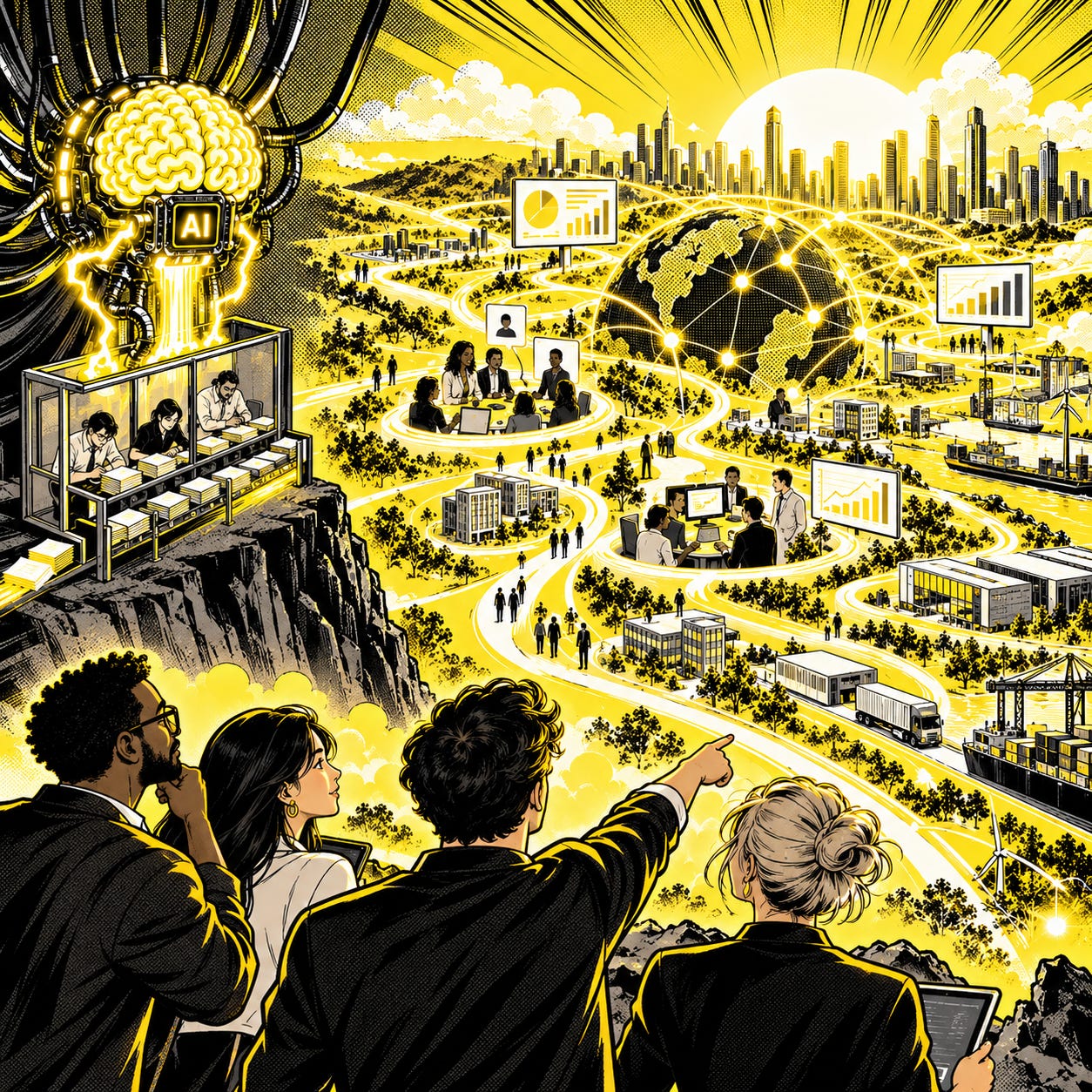
TLDR:
We risk using AI to make yesterday’s narrowly designed processes dramatically more efficient. But many of those processes were designed around a world where intelligence, information processing and coordination were expensive. AI changes those constraints.
Which creates an interesting possibility: The process you are trying to improve may simply be too small. Not too small in terms of volume, people or importance. Too small in terms of what it considers, what it influences and what it is trying to achieve.
As a consultant, a core part of my job is going into companies and organisations and rapidly understanding what they do, how they do it and why.
Increasingly, the reason for doing that is to help them create competitive advantage through the deliberate adoption of AI.
The obvious place to start is often their processes. Processes that have been honed over years to work for their people, customers and markets. Processes where we can usually see plenty of evidence of change, experimentation and optimisation to make them faster, cheaper, more efficient or effective.
We also normally find opportunities that haven’t been spotted by the people running them today. That isn’t because those people aren’t good at their jobs. It is because a different perspective often reveals different possibilities: ideas from other sectors, new tools, different techniques or simply someone asking a question that hasn’t been asked before.
Into this mix comes AI, and the natural question becomes:
How can we use AI to run this process better?
I’m increasingly wondering if that is the wrong question. Because we may be about to use extraordinarily capable technology to optimise processes whose boundaries and goals were created around constraints that may no longer apply.
We designed processes to be manageable
Every business-critical process has some form of goal. Often those goals become measures such as:
Time to market
Lead time
Cost to serve
SLA performance
EBITDA
Profit margin
Average handling time
The better processes have leading and lagging measures. The really good ones understand variance and continually experiment to improve performance.
Metrics are useful because they focus people. They are easy to communicate, easy to remember and, conveniently, easy to put into somebody’s objectives or bonus scheme.
But we also know what happens when the metric becomes the goal. We have seen organisations optimise financial performance while losing sight of safety, quality or customers.
I once worked somewhere with a major focus on Average Handling Time. I used to half-joke that, given the way the objective was written, I could earn a fantastic bonus by cutting the phone lines. Spoiler: we didn’t.
The deeper issue, though, is that we haven’t just created narrow measures. We have also created narrow processes. And there is a good reason for that.
Coordination, context and attention are expensive.
A team can realistically optimise the bit it owns. It can reduce handling time. Improve its SLA. Lower cost. Remove a hand-off. Increase throughput.
But looking across five systems, three departments, previous customer interactions, external signals and all the downstream consequences of a decision require considerably more effort.
So, organisations break complicated systems into manageable chunks.
Customer Service handles the complaint
Recruitment fills the vacancy
Operations process the order
Marketing generates the lead
Each function gets a process
Each process gets a goal
Each team optimises its part
That is entirely understandable when human attention, analysis and coordination are scarce. But AI changes the economics that created those boundaries.
AI changes the optimisation boundary
An AI-supported process can potentially:
Sense more context, reason across more variables, coordinate more actors, personalise decisions and continually learn from outcomes.
Things that were previously too difficult, expensive or slow to consider as part of a single process become much more achievable. Which creates an interesting possibility. Perhaps the opportunity isn’t simply to make the existing process better. This is where I think AI may have just made your process too small. The boundaries that once made it manageable may no longer be the boundaries that make sense. And if the boundary becomes larger, the goal probably needs to change with it.
Don’t redesign the process. Redesign the goal.
Take a mundane process such as handling a customer complaint. A traditional goal might be:
Resolve 90% of complaints within 48 hours.
A slightly more sophisticated version:
Resolve complaints quickly while maintaining customer satisfaction.
Both sound perfectly sensible. But zoom out. What is the organisation actually trying to achieve? Perhaps something more like:
Restore the customer relationship, resolve the underlying cause, prevent recurrence and use the signal to improve the wider business.
That is a very different goal. And once the goal changes, the process changes. An AI-supported process might connect:
Customer complaint → Customer history → Product issue → Similar complaints → Operational root cause → Retention risk → Remediation → Product/process change
The complaint is no longer merely a ticket to close. It becomes a signal within the wider business system. That is the shift I think we should be paying much more attention to. Not simply from manual processes to AI-supported processes. But from process goals to system goals.
How far can you zoom out?
You might think about the evolution like this:
Task optimisation
“Do this step faster.”Process optimisation
“Complete this process better.”Journey optimisation
“Improve the outcome for the customer.”System optimisation
“Create the best overall outcome across the customer, organisation and wider system.”Adaptive system optimisation
“Continually learn which actions create the best long-term outcomes.”
AI makes the final two considerably more achievable than they were before. Not because AI magically removes every organisational boundary or trade-off. It doesn’t. But it increases the amount of context we can economically observe, understand and act upon. And that means we can ask a much more interesting question:
“What wider outcomes could this process contribute to if:
We stopped defining its purpose so narrowly?”
Take recruitment A narrow process goal might be:
Fill vacancies within 45 days.
Perfectly measurable. Perfectly sensible. And potentially far too narrow.
Zoom out and the organisation might actually care about:
Organisational capability
Diversity of thinking
Employee retention
Skills required in three years
Workforce cost
Internal mobility
Culture
Candidate reputation
Productivity
Now, these outcomes won’t always agree with each other. Reducing time-to-hire might conflict with finding a better long-term candidate. Workforce cost might conflict with capability. Internal mobility might conflict with filling a role as quickly as possible.
AI doesn’t make those trade-offs disappear. Nor should we hand over the definition of what matters to an algorithm. But it does make it more feasible to consider a portfolio of outcomes instead of allowing one convenient metric to become the definition of success.
An AI-enabled recruitment process could sense and reason across far more of that wider context than a traditional process could economically manage. Which brings us back to the central point:
The tendency is to use AI to redesign the process when the real shift in thinking may be to redesign the goal first. I suspect that you may well have been asked at some point to “AI that process” and not be given the opportunity to zoom out. There are sound economic arguments that can help you here. Firstly, for a small additional investment your process can be much better and secondly it will likely be months/years before you revisit, the combined value of zooming out is considerable.
Only once we know what we’re genuinely trying to achieve should we ask what an AI-supported process would need to observe, decide and act upon to achieve it.
Try it on one of your processes
Take a process you know well and work through these questions.
Current process
What does it do? Don’t overthink it. What is the thing your organisation currently believes this process exists to do?Current goal
What metric are we actually optimising for? Not what the strategy deck says. What behaviour do the measures really encourage?Zoom out
What larger system is this process part of? What happens before it? What happens afterwards? Who else is affected?Wider outcomes
What would we care about if organisational boundaries and human processing capacity were less constraining? What outcomes are currently ignored because they are somebody else’s problem, too difficult to measure or simply too expensive to coordinate around?AI opportunity
What could we now sense, understand, predict, coordinate or act upon that wasn’t economically feasible before? This is where AI becomes useful. Not as the starting point. As the enabler.Better goal
What should the wider system actually optimise for?
You may discover that the answer is quite different from the metric sitting on today’s dashboard. And that may be the biggest AI opportunity of all.
We designed many of our processes around the limits of human coordination. Those limits encouraged narrow process boundaries. Narrow boundaries encouraged narrow metrics. And narrow metrics encouraged local optimisation. AI changes some of those constraints. So perhaps before asking:
“How can AI improve this process?”
We should ask:
“Is this still the right process boundary, and are these still the right goals?”
Or, put even more simply:
“If AI makes intelligence cheap, are our existing process goals still the right goals?”
Because the biggest opportunity from AI may not be making your existing process faster, cheaper or smarter. It may be realising that AI just made your process too small.